So many folks to thank since it's official as of an hour ago: the book-and-arts tour's officially funded with the help of more than 50 backers!
Here's a thank you toast to the following folks who are making this tour monetarily possible (There are many, many more who are sending notes of encouragement, buying the book, hosting and attending tour events and workshops, etc. etc!). So in no particular order:
Rolf Potts
Jayne Byler
Laura Grimm
Reyna Clancy
Carol Beale
Willa Carroll
Denise Vigneron
Donna Lofgren
Sarah Green
Bob and Trisha Lachman
Dennis Davenport
Aimee Anderson
Heather Frese
Kevin Haworth
Kelly Cooke
Sarah Einstein
Sarah Ellen Mitchell
Laura Kung
Amy Juravich
Joel Miller
Ashley Seitz Kramer
Sarah Kraybill Burkhalter
Angela McCutcheon
Patti Rossiter
Adel Wang
Hank and Marilyn Rossiter
Ruth Lapp Guengerich
Heidi Bender
Ben Lachman
Kathy Mast
Ruth Amstutz
Helen Horn
Wendy McVicker
Caitlin Mackenzie
Peter G. Jarjisian
Julia Lichtblau
Jen Hinst-White
Joe and Ashley Dallacqua
Kari Gunter-Seymour Peterson
V. Hansmann
Hillary Dorwart
Jen Colatosti
Deborah Michel Rosch
Sara Gilfert
Eric and Kristin LeMay
Michael Lachman
Heather Frese
Elizabeth Witte
Annah Korpi
Ada Tseng
Amanda Remnant
Sunday, April 8, 2012

Mennonite/s Writing: HARRISONBURG, VA
Easter Sunday, and more perennials--wild ginger, phlox, daffodils--are happily tucked into our land. Every year, we plant spreading greenery, hoping one day not to have to haul out the clippers and mowers on our San-Fran-like hills. (We're even considering getting a goat to help us with this job.)
Yesterday, we tended to our acres for blissful hours, cancelled social plans, felt the sun remember our faces. Slow down, our lives had been tea-kettle-whistling. Why must we wait until a Holy Day to listen?
Today we ate breakfast--local eggs and donuts, strong coffee--and read aloud from Mary Oliver: "Don't bother me. I've just been born." We ducked into the old cemetery right across the street to remind ourselves of our living. Later, I will listen to a podcast from my home church three hours away, mostly to hear the hymns and to recognize the voices of people I know. (I sang my favorite Easter hymn in the shower this morning-- "Up from the grave he arose!"--but it's just not the same without that jovial bass line.) Soon, we'll go to restorative yoga to remember how the soul is planted in a body--on purpose. The late afternoon sun shines through blue and green bottles in our side windows, and Beef Bourguingnon (OK, the cheater's version of it!) bubbles away at the stove.
There are many kinds of redemption.
Last weekend, I was honored to read from my book and to give a lecture on "creative nonviolence" as pedagogy at the 6th Mennonite/s Writing Conference, held at Eastern Mennonite University in Harrisonburg, VA. (Check out my Mennonite World Review post about the conference here.) The conference ended on Palm Sunday, the same day my book of poems officially released.
I'm finding that having a book out there makes you look at your own creative work with a transformative eye. I was that person, I find myself saying to myself. My life has taught me this..., and Look how the Spirit moved. I also find myself wanting to make revisions to these now-published poems--to stretch a line or delete a word. Who knows: when I read them in public, they may show up wearing something a little different--another ending, an alternative line break, a slight twist of adjective. Does the transformation process ever really end?
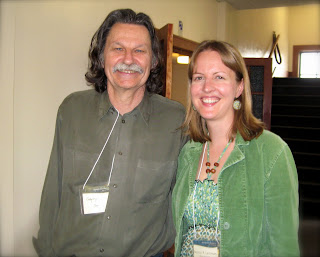
The poet Gregory Orr offers this line: “Praising all creation, praising the world: / That’s our job—to keep / The sweet machine of it / Running smoothly as it can.” Mr. Orr spoke at the Mennonite's Writing conference about the ethical responsibilities of lyric poetry, which means the "I" can be transformed, move beyond the individual and out into the world. Selah. Alleluia. Whatever slows you down, may it help you step out into the bigger world, renewed.
 With poet Gregory Orr
Yesterday, we tended to our acres for blissful hours, cancelled social plans, felt the sun remember our faces. Slow down, our lives had been tea-kettle-whistling. Why must we wait until a Holy Day to listen?
Today we ate breakfast--local eggs and donuts, strong coffee--and read aloud from Mary Oliver: "Don't bother me. I've just been born." We ducked into the old cemetery right across the street to remind ourselves of our living. Later, I will listen to a podcast from my home church three hours away, mostly to hear the hymns and to recognize the voices of people I know. (I sang my favorite Easter hymn in the shower this morning-- "Up from the grave he arose!"--but it's just not the same without that jovial bass line.) Soon, we'll go to restorative yoga to remember how the soul is planted in a body--on purpose. The late afternoon sun shines through blue and green bottles in our side windows, and Beef Bourguingnon (OK, the cheater's version of it!) bubbles away at the stove.
There are many kinds of redemption.
Last weekend, I was honored to read from my book and to give a lecture on "creative nonviolence" as pedagogy at the 6th Mennonite/s Writing Conference, held at Eastern Mennonite University in Harrisonburg, VA. (Check out my Mennonite World Review post about the conference here.) The conference ended on Palm Sunday, the same day my book of poems officially released.

I'm finding that having a book out there makes you look at your own creative work with a transformative eye. I was that person, I find myself saying to myself. My life has taught me this..., and Look how the Spirit moved. I also find myself wanting to make revisions to these now-published poems--to stretch a line or delete a word. Who knows: when I read them in public, they may show up wearing something a little different--another ending, an alternative line break, a slight twist of adjective. Does the transformation process ever really end?
The poet Gregory Orr offers this line: “Praising all creation, praising the world: / That’s our job—to keep / The sweet machine of it / Running smoothly as it can.” Mr. Orr spoke at the Mennonite's Writing conference about the ethical responsibilities of lyric poetry, which means the "I" can be transformed, move beyond the individual and out into the world. Selah. Alleluia. Whatever slows you down, may it help you step out into the bigger world, renewed.

Sunday, March 25, 2012
Kicking off the Book-&-Arts Tour!

Though this may come as a shock to some purebred Mennonites, I just took my 1st trip to Kansas. Why? I accompanied my 82+-year-old grandma to visit relatives, an adventure that let me see her feistier side (and that indeed, one can fit several wheels of baby swiss cheese and rings of Trail bologna into a carry-on).
Sometimes, things just align in life. When they do, the best reaction is to enjoy the bridges built, not to fight or ignore them (though we sometimes do, yes?) For me, what I will eternally call "The Kansas Weekend" was proof of such Greater-Than-Me alignments. Not only did I have the chance to take a trip with the family matriarch and to see distant cousins, I also reconnected with literary friends who now make their home in Lawrence.

What do writers and lit folks do when they haven't seen each another for years? We have a writers' salon! We add a voice to our Voice! We eat good food and words! We say, "Wow. That was great. I want seconds." We remind each other that writing, in the end, is not a solitary act if we want to live out a rich life of letters. Now mind that word "rich" --please think of the best dessert you've ever eaten instead of dollar bills or tenure contracts. Let's be real here--I'm a poet and songwriter. The work I love most is not done for the sake of a steady paycheck. And yet, when you find yourself in community with artists & writers, your life doesn't walk away empty-handed.
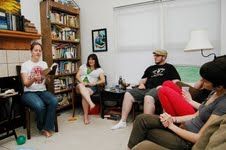
The Lawrence Writers' Salon (filled with some wonderful people I met for the first time and also some dear friends) was my first stop on a book-and-arts tour for my first poetry collection and in celebration of the role of the artist within community, a tour that's been generously (generously!) funded by over 40 folks--friends, family, even strangers--who care about the role of story and mentorship and who want to see contemporary poetry thrive. (MORE ON THESE TOUR BACKERS LATER!) Funds raised will help me travel to different Mennonite-affiliated communities to teach free storytelling and poetry writing workshops for intergenerational women. Many, many other folks are contributing to the tour through buying the book, "holding it in the Light" as the Quakers say, and spreading the word.
Feeling already uber supported among the KU writers' community, I had one more stop to make. The cherry on top of "The Kansas Weekend" came in the form of a special collections library. KU has a pretty great sampling of William Stafford material (Stafford is a poet and human being I greatly admire, and he earned his masters at KU.) I got to hold letters he wrote on his typewriter in Oregon, with his tilting cursive signature in blue pen at the bottom. I got to meet poems of his I'd never known before.
And isn't that what life is all about? Piece-by-piece and person-to-person, we fill in the blanks we never knew were missing. Sometimes, even, we begin to see a bigger picture, start walking in a different direction, simply because suddenly we can. "Step-by-step," the old social justice tune sings, we march the march of the day. And word-by-word, we make a poem out of something that wells up in our living. "To live poetry is better than to write it," Basho said.
I copied and brought back with me several new bits of Stafford wisdom from the KU research library. In "Notes for the Refrigerator Door," he muses, "In any house there should be much reading that has never been published, that is in all states--notes, a start, a stop, the pieces that got said without presuming to be more than they are. Most things aren't finished, and most things haven't yet found their right beginning. Beyond poetry, there is a prose of the way things happen."
I have no idea what to expect from the book-and-arts tour that's only in the brainstorming stages. But I have faith in the gravity of unfinished work--and in bridges of all shapes and sizes.
-------------------
Special thanks to Jana Tigchelaar for the KS photos

Tuesday, February 28, 2012
THE APPLE SPEAKS: IT'S ABOUT TO SING!
Some things just need time to bake, and the end result is worth the wait. This is a lesson I've learned as an adult who often views cooking as a form of everyday meditation and mindfulness.
It's also the lesson I learned while putting together my first poetry manuscript, THE APPLE SPEAKS, which is now available for pre-order on Amazon and other online sites. Some of the poems in this book were started when I was 19, what seems a life-time ago. In the course of revising and editing the book's pages, I've had the opportunity to add my now 31-year-old voice to many stanzas, asking my many "selves," if you will, to sing together.
I'm excited that this collection has been published by an Anabaptist-afilliated press, Cascadia/Dreamseeker Books. This puts the book into the hands of the audience it's possibly most meant for--and the audience I tried NOT to imagine reading it. Ah, yes. The old question of opening our mouths in public--or rather, in publication.
I'm planning a book-and-arts tour of sorts starting this spring--after April 1st, the book's official release date. More news to come, more songs to sing...STAY TUNED!

It's also the lesson I learned while putting together my first poetry manuscript, THE APPLE SPEAKS, which is now available for pre-order on Amazon and other online sites. Some of the poems in this book were started when I was 19, what seems a life-time ago. In the course of revising and editing the book's pages, I've had the opportunity to add my now 31-year-old voice to many stanzas, asking my many "selves," if you will, to sing together.
I'm excited that this collection has been published by an Anabaptist-afilliated press, Cascadia/Dreamseeker Books. This puts the book into the hands of the audience it's possibly most meant for--and the audience I tried NOT to imagine reading it. Ah, yes. The old question of opening our mouths in public--or rather, in publication.
I'm planning a book-and-arts tour of sorts starting this spring--after April 1st, the book's official release date. More news to come, more songs to sing...STAY TUNED!

Tuesday, May 3, 2011
A "Dirty" Book Worth Reading
The Dirty Life: On Farming, Food, and Love by Kristin Kimball. Read my review here: http://www.alimentumjournal.com/the-dirty-life.
Monday, May 2, 2011
Loving (All) Life?
The Green has come to get us.
Know what I mean? I stand on our deck and see a lawn that's enjoyed day after day of rain and no mower; deciduous trees that are singing a cappella the only way they know how: in color. Emerald, lime, forest-hued. The green is taking over! And in our busy lives, we let it.
Sometimes, I feel like our busyness grows thick stalks of discontent: social malnourishment. And yes: we let it happen. I am part of this relentless Greek chorus. Saying "no" to socially constructed norms takes too much energy. Changing is painful or difficult. We forget what is human. We forget what is Awesome in the original context of the word.
I've been quiet on this blog for the past couple of months because of my own hectic life-weight as I finish my MFA in creative writing and start answering the question that stubbornly waits behind most conversations: "What are you planning to do when you graduate?"
For artists, this question is troubling. After all, shouldn't my answer just be, "I'm going to create something"?
In many ways, we still live in a culture that distrusts a woman who's not sure she wants to be a mother, and I've learned to nod and smile when folks hint that Now, I can start a family. And we live in a world that expects that I'll get a raise or a full-time job when I add another degree to my CV, so I've also learned to be honest only with select folks. People who know me well also know that I question the ethics of two middle-to-upper-class partners bringing home full paychecks when taxes go towards so much destruction (the U.S. has a bigger military budget than most of our allies and enemies combined), and when so many folks within our own borders can't afford their basic needs.
I don't want more stuff: I want more life.
I keep dreaming about a purpose outside of full-time academia. This is a big switch for me, one that's been growing for years. I love teaching...but I don't love many of the layers involved in higher education's potential evolution. A desperate green, in many ways, has come to get us--and it shows. Money, elitism, injustice. Just like peace, violence comes in many forms.
For a few months now, I've been attending "Farm Church." Every Tuesday, a small group of people (and one elderly dog and several attention-hungry cats) gather in a local farmhouse living room for mass. A potluck follows (what I call "real" communion), or walks around the farm, which houses an intentional community and grows produce for local food banks. This place and the people drawn to it-- imperfect but striding forward--give me hope. And yes, the color most associated with hope? Green.
I come from a family and culture of farmers, yet I'm distanced from asking things (other than metaphors, student minds, and song lyrics) to grow. When did this deep disconnect happen? It's a question many contemporary Mennonite families ask from time to time. As Di Brandt writes when considering how to be a "good" Mennonite woman and, at the same time, a poet immersed in the complex greater world: "How can I be both and not fly apart?"
How can I be an American and a pacifist and not fly apart? How can I crave individualism as much as community and not fly apart?
Today, when my heart was heaviest, it helped to remember the pockets of "green" around me. I did not celebrate the murder of bin Laden, a man taught to hate, educated in destruction. My tax dollars, after all, helped this to happen. If you grow terrorism, the crop keeps coming back.
There are other ways to cultivate.
When my grandpa was drafted into WWII, he joined Civilian Public Service, where he parachuted from planes into forest fires in the American West, one of 300 C.O. smokejumpers. He left his farm work to quietly wage peace, unpaid and without parades when he came home. It was an inviting adventure, yes, but choosing life--all life-- was at the root of his identity and faith. Today, we're lucky to hear a peace sermon, even in an historic "peace church." How many Christians (me included) keep Jesus securely on the cross--or in some distant heaven--in order to (sub)consciously ignore his radical life example, his teachings of love and reconciliation?
I often wonder what it would take for our current wars to end or for our dependence on force to shift. For now, I want my daily choices to reflect a call towards life. I can't stop a war on my own. But I can change my life to walk towards peacemaking, perhaps only one gentle nudge at a time.
"I feel our souls all need band-aids right now, but we don't even know it," a friend wrote to me earlier today. We are flying apart...We are flying apart...
Maybe tomorrow, we can stop to catch our breath, can connect to the life--and lives--around us. Beyond us. Maybe it's as simple as learning your neighbor's name. Or bending down to loose a dandelion from your driveway. Any start will do. Any start at all. I believe in a peace that has a vast tiara of roots, even on days when one murderer boasts that (s)he's killed another murderer first.
What are we going to do next? Which way will we reach with more than a little rain?
---------------
To see photos of my grandpa and other Wayne Co. Mennonite men in WWII Civilian Public Service, visit: http://www.flickr.com/photos/peaspoet/sets/72157626333228805/with/5601580909/
Know what I mean? I stand on our deck and see a lawn that's enjoyed day after day of rain and no mower; deciduous trees that are singing a cappella the only way they know how: in color. Emerald, lime, forest-hued. The green is taking over! And in our busy lives, we let it.
Sometimes, I feel like our busyness grows thick stalks of discontent: social malnourishment. And yes: we let it happen. I am part of this relentless Greek chorus. Saying "no" to socially constructed norms takes too much energy. Changing is painful or difficult. We forget what is human. We forget what is Awesome in the original context of the word.
I've been quiet on this blog for the past couple of months because of my own hectic life-weight as I finish my MFA in creative writing and start answering the question that stubbornly waits behind most conversations: "What are you planning to do when you graduate?"
For artists, this question is troubling. After all, shouldn't my answer just be, "I'm going to create something"?
In many ways, we still live in a culture that distrusts a woman who's not sure she wants to be a mother, and I've learned to nod and smile when folks hint that Now, I can start a family. And we live in a world that expects that I'll get a raise or a full-time job when I add another degree to my CV, so I've also learned to be honest only with select folks. People who know me well also know that I question the ethics of two middle-to-upper-class partners bringing home full paychecks when taxes go towards so much destruction (the U.S. has a bigger military budget than most of our allies and enemies combined), and when so many folks within our own borders can't afford their basic needs.
I don't want more stuff: I want more life.
I keep dreaming about a purpose outside of full-time academia. This is a big switch for me, one that's been growing for years. I love teaching...but I don't love many of the layers involved in higher education's potential evolution. A desperate green, in many ways, has come to get us--and it shows. Money, elitism, injustice. Just like peace, violence comes in many forms.
For a few months now, I've been attending "Farm Church." Every Tuesday, a small group of people (and one elderly dog and several attention-hungry cats) gather in a local farmhouse living room for mass. A potluck follows (what I call "real" communion), or walks around the farm, which houses an intentional community and grows produce for local food banks. This place and the people drawn to it-- imperfect but striding forward--give me hope. And yes, the color most associated with hope? Green.
The Good Earth Farm from dan krauss on Vimeo.
I come from a family and culture of farmers, yet I'm distanced from asking things (other than metaphors, student minds, and song lyrics) to grow. When did this deep disconnect happen? It's a question many contemporary Mennonite families ask from time to time. As Di Brandt writes when considering how to be a "good" Mennonite woman and, at the same time, a poet immersed in the complex greater world: "How can I be both and not fly apart?"
How can I be an American and a pacifist and not fly apart? How can I crave individualism as much as community and not fly apart?
Today, when my heart was heaviest, it helped to remember the pockets of "green" around me. I did not celebrate the murder of bin Laden, a man taught to hate, educated in destruction. My tax dollars, after all, helped this to happen. If you grow terrorism, the crop keeps coming back.
There are other ways to cultivate.
When my grandpa was drafted into WWII, he joined Civilian Public Service, where he parachuted from planes into forest fires in the American West, one of 300 C.O. smokejumpers. He left his farm work to quietly wage peace, unpaid and without parades when he came home. It was an inviting adventure, yes, but choosing life--all life-- was at the root of his identity and faith. Today, we're lucky to hear a peace sermon, even in an historic "peace church." How many Christians (me included) keep Jesus securely on the cross--or in some distant heaven--in order to (sub)consciously ignore his radical life example, his teachings of love and reconciliation?
I often wonder what it would take for our current wars to end or for our dependence on force to shift. For now, I want my daily choices to reflect a call towards life. I can't stop a war on my own. But I can change my life to walk towards peacemaking, perhaps only one gentle nudge at a time.
"I feel our souls all need band-aids right now, but we don't even know it," a friend wrote to me earlier today. We are flying apart...We are flying apart...
Maybe tomorrow, we can stop to catch our breath, can connect to the life--and lives--around us. Beyond us. Maybe it's as simple as learning your neighbor's name. Or bending down to loose a dandelion from your driveway. Any start will do. Any start at all. I believe in a peace that has a vast tiara of roots, even on days when one murderer boasts that (s)he's killed another murderer first.
What are we going to do next? Which way will we reach with more than a little rain?
---------------
To see photos of my grandpa and other Wayne Co. Mennonite men in WWII Civilian Public Service, visit: http://www.flickr.com/photos/peaspoet/sets/72157626333228805/with/5601580909/
Friday, February 18, 2011
False Spring

Figure 1.1
February 17. 65 degrees in SE Ohio. Our minds shift to "April" "earth," "skirts." We check lawns for daffodils-in-the-making, our laundry remembering how to flap. No one checks the 10-day forecast. We don't want to know.
Figure 1.2
On my way to play piano for a college ballet class, I spot a sunflower the size of my palm on the sidewalk ahead. Escaped from a bouquet? I think, excited, Or a sign that spring's settled in? I reach down to be its rescue--find out it's plastic. The rest of my day feels the same.
Figure 1.3
A college town openly displays its secrets, especially when snow finally melts. Crushed green glass and leopard bikini briefs, abandoned; an open pizza box with a necklace inside; cigarette butts, the tail-ends of conversations never finished. This time of year, the ground can reflect us.
Figure 1.4
For seven weeks, I gently build up to two questions, give my college students hard homework: What does it mean to be a writer in a time of war?, What would you ask a soldier if you could ask anything? Only half the class shows up to answer. I come home and pull the covers over my head, just another bulb.
Figure 1.5
The full moon pulls out dreams like silk pajamas from open drawers. For weeks, my sleep's been filled with characters in plain dress, actors in bonnets or suspenders pretending to be something they're not. I am the one who calls them out, reveals their false identities. Exact accusations from these dreams: "Who's your bishop?," "What have you given up?," "What's your favorite cheese?" The question I get most often about my upbringing: "What makes you different from me?" Sometimes, it also feels like accusation.
Figure 1.5a
Last night, I was going to build a house on the edge of my grandpa's farm--but in the dream, I didn't recognize the land. I wake up frightened.
Figure 1.6
The wind stirs up more questions, allergies, afternoons under the covers. How long can a Mennonite last without community?, Have the squirrels eaten all the daffodil bulbs?, Could my students spend a whole day in silence? Could I?, Who will shake our lives gently, tell us, 'Shhhh--You've just been dreaming'?
Figure 1.7
Even Thoreau kept secrets hidden by the louder things he said, had his mother do his laundry. The wind blows our socks from the clothesline and into the woods. The president gives a speech. We forget what we're funding. It's too warm to care. I may never know what my students have learned from me.
Figure 1.8
Accepting the shape of one life takes practice. Remember asking for someone to help you trace the outline of your body on a sheet of torn-off paper? Did you recognize yourself as only border? I swear, just now, I smelled what the garden could be.
(Photo by Nico Nelson on Flickr)
Subscribe to:
Posts (Atom)