Friday, February 15, 2013

The Next Big Thing Blog Hop


My friend & poet Jeff Tigchelaar recently asked me to participate in The Next Big Thing Blog Hop, where writers describe the projects they're working on.  I’ll answer his questions below, then send them on to five more writers...and the happy dance continues. This may seem like a strange chain-letter of sorts, but ask any artist how it feels when someone (other than our spouses) takes the time to ask, "How's your work going?" It's pretty wonderful. 
Jeff’s responses are here at his blog, and a list of the writers who've taken part in The Next Big Thing Blog Hop can be found here. 
I'm ruminating on three book ideas--one nearing completion (poetry), one partly done (also poems), and one in the brainstorming stages (personal essays). But the project I'm sleeping/eating/breathing right now is a book full of others' work... See below.
What is the working title of the book?
Where did the idea come from for the book?
In 2010, I stumbled across the fact that American poet William Stafford served as a WWII conscientious objector in Civilian Public Service (CPS) during the same time as my maternal Grandpa, Ivan C. Amstutz. To be honest, during most of my MA/MFA in poetry, Stafford wasn't even on my radar. In my mind, he was just another white American poet-patriarch. I was much more interested in international poetry and poetry by women. But when I began reading about Stafford's life example, starting with his master's thesis Down in My Heart (a creative nonfiction account of his CPS days), I was hooked and inspired and-- ultimately -- rejuvenated as a writer. At the time, I was questioning whether I wanted to be part of academia and what "success" would look like post-MFA. Stafford challenged me to do some real soul-searching.
And then, the Universe seemed to be tapping me on the shoulder wherever I went. Every poet I was befriending had a Stafford-related memory, poem--even dreams! When I looked on Amazon for an anthology of these Stafford-inspired poems/experiences, I found...nothing. 
With Stafford's 100th b-day coming up in 2014, I decided that editing an anthology of poems inspired by the life and work of Wm. Stafford would 1) be the closest thing to meeting him and thanking him, and 2) would hopefully encourage more discussions around his  ideas and teaching methods, some of which still get people all riled up (Just watch the trailer to this Stafford-inspired film Every War Has Two Losers, and you'll see what I mean.)
What genre does your book fall under?
Poetry. 
What actors would you choose to play the part of your characters in a movie rendition?
Wow. It's impossible for me to imagine anyone else but the actual living poets in a movie version of this book, all sitting around a great table and talking about life. Wouldn't that make a great reality TV series? Let's get all these poets together (preferably in a beach house) and discuss all those unanswered questions Stafford posed! We could bring in some "Amish" people, just to get more viewers! Haha.
What is the one-sentence synopsis of your book?
How might we honor/grapple with/challenge/respond to William Stafford today?
How long did it take you to write the first draft of the manuscript?

This is my first big editing project, so I'm learning as I go... Some days it feels like Christmas. Some days, I'm so moved by the letters and submissions, I sit at my computer all misty-eyed. Other days I ask myself, "How did I get myself into this?" 

I'm in month #8 of the editing process. Since last summer, I've been querying presses about the idea, writing up proposals, and tapping possible contributors on the shoulder. I think it's pretty amazing that the press who said yes (Woodley P) was #13, just as 2013 started up. A good sign!

As for the book's content: One poet said he'd written his submission 25 years ago and never assumed it would be published; another said she wrote hers last week, getting up every morning to write, just as Stafford did. Some of the poems have been previously published, but so far, more than half are new or never-before-published.


Who or what inspired you to write this book?
Honestly, I wanted to connect with other writers and readers of poetry who believe in a better world. I needed to know they exist, and that poetry can still inspire conversations that change us, not just entertain us. I love a good challenge, and I want this anthology to be a real dialogue--no "sainting" Stafford. 
Stafford was a poet-teacher who never stopped believing in "the greater good," even in the worst of times. But he knew it would take a lot of work and transformation. I want to be like that/live like that, too.
What else about your book might pique the reader’s interest?
So far, poets like Ted Kooser, Susan Kinsolving, Kim Stafford, and Dan Gerber have contributed NEW poems for the anthology. It's very exciting. I've been using the phrase "humbling bliss" a lot. 
Look for the book--complete with a study section for use in classrooms/writing groups--this November! 
A few of my favorite writers who will (or have been asked to) answer these questions next week:
Carrie Oeding, Kent Shaw, Robert V. Hansmann, James Dickson, Sarah Green
-----------------------------------
Becca J.R. Lachman teaches and tutors writing at Ohio University. Her 1st poetry collection The Apple Speaks (Cascadia House, 2012) is dedicated "to humanitarian workers around the globe, but more for the families who love them."

Thursday, February 14, 2013

A Blank (Heart)Slate


My good friends who know how I feel about the interconnectedness of big identity issues in America today (feminism, activism, materialism, etc.) tend to cock an eyebrow at my unshakable respect for Valentine's Day. But once I tell them my story--how one of my grandmothers doesn't give gifts for Christmas but sends out letters and gifties to her grandkids for Feb 14 instead, and how female mentors have literally saved my life, one belly laugh and snail-mail letter and girls' night out at a time--they start to get it.

This time of year, I often hear, "Why do we need a day to remind us to love?" or some form of that question in the air. And here's my answer: "How can we not need a day to remind us to love in today's world?" Now, my V-Day isn't filled with chocolates or flowers (though I ADORE the local chocolate and florists in my town, along with the amazing women behind them). My Valentine's Day is fueled by mindful connection.

I generally send out about 30-40 handwritten Valentines/year, and mostly to either the most important women in my life, or the friends I don't often get to see in person. It's a time to be intentional about actually reaching out to people who have made me stronger/wiser/grateful in the last year. We live in a society that now tells us that if we want to "know" someone, to feel connected with their lives, we only need a texting plan, or just need to show them we care by "liking their posts" (I sometimes wonder what American pioneers would say to this odd phrase/action!) But friends (Self, are you listening too?): I'm writing to say this is not enough! There's more than this.

When I send off a Valentine or call someone up on Feb 14, I'm thanking the Universe that this woman is here--here now--in my life and the life of others. And to be completely honest, it's also one week of the year when I can celebrate the fact that I am still here, too, that I am a woman with many privileges and blessings, and that I have the opportunity to reach out to my best self--with the help of friends, and with the help of self-compassion. I can, as a local nonprofit signs its emails, "make love a verb," starting with learning to love my present self.

I deliberately plan activities in my week that make me--yes, make me--acknowledge my strength and beauty as an individual. Yoga, writing, and morning devotions (usually a prayer or poem or song) makes me slow down and nod to who I've been in the past--and who I want to become before the day blasts into any to-do list.

So if I was handing out candy hearts today, at age 32, they might offer, "Forgive yourself," "Let it go," "Renew," "See the beauty in the next stranger you meet," and "You're here now."

I remember putting candy hearts on the desks of boys I liked in 2nd grade, when I was literally about a head taller than all of them. It was before recess ended, and I recall the fiery rush of adrenaline and hope as I carefully chose which hearts went on what desks--before the bell!

And friends, I've been repeating this action ever since, decades later. I'm still that girl asking to be noticed for her worth, and I'm still the person wanting to exclaim to those around her, "I see you. You're lovely. You're OK." It just took me about 25 years to figure out that the person I needed to love in public--more than any man, or partner, or friend--was myself. And what a challenging Valentine invitation that's become every year..."Self, I accept you. Self, how will you define beauty today?"

May you eat something sweet today, whether it's chocolate or a true compliment someone gives you. May you smile at the college boys selling roses. And may you take a deep breath and walk out into the world with greater self-compassion. Our hearts are blank slates. Let's be mindful of what we've written there.

Tuesday, January 29, 2013

Insurance and "Wordles"

This morning, I sat down with our State Farm insurance agent to go over existing policies--one of the many things on my "being grown up is surreal" list, mostly because I'd made an appointment to listen to a stranger describe all the things I was supposed to be afraid of.

As a Mennonite, this kind of meeting also makes me uncomfortable.  And sad. There was a time when more Mennonites and other Anabaptists didn't buy into most insurance plans.  If something happened--fires, sickness, theft, injury--the church would step in to see you through. We made our own commitments to each other, unspoken and spoken.

I calmly reminded the agent that no, I wouldn't take anyone to court if they wrecked into my car and didn't have insurance. No, I didn't want life insurance at this time, and that my husband and I had talked it through. No, I don't want my home owner's insurance policy to cover any jewels or furs or firearms, and no, I don't have an iPhone, can you believe it? Will not be getting one, no. I don't want to be "connected" all the time. And yes, I've heard the statistics about how many people use tablet computers these days. No,  I don't have a texting plan for my phone, and I don't really want to know what app may "change my life forever." And every time Diane Rehm says "Send us a Tweet," I want to die a little inside.

I'm more interested in poems inside us, I wanted to tell her, the ones that sometimes also change our lives forever. What poem keeps your mind and body humming? What poet visits you in dreams? And do you have special insurance for poets--you know, to cover submission mailings, contest fees, residency application fees, especially when a poem gets rejected, or isn't even read by an editing staff who sends you a rejection email that could've been written by my cat in a bad mood? Or how about those visits to the shrink, the life planner, or those extra vacations taken because (most of) the world thinks you're  [ fill in the blank ] for wanting to write poems and read poems and talk about poems like some people talk about the latest features of their newest gadget?

I kept quiet, of course. Smiled and signed/dated next to my signature that looks like my Grandma Ruth's cursive. She was a 3rd grade teacher and taught me how to lean my R's just so.

After walking home from my visit with the insurance agent, I sat down at my writing desk and saw the "Wordle" I'd printed out, a word cloud generated from all the text in my first book of poetry. Up until this week, I didn't know the word or the "Wordle" itself existed. The largest words in a Wordle are those that appear most often in the collection, then the middle-sized words, and so on. I started to think about how long it took me to shape this book--10 years--and how my next collection will house different words that swim to the surface most often.

I'm not completely naive. I know that life sometimes changes with the blink of an eye, and having insurance can be important in an individualistic world. But what do I want to leave behind? I'm grateful to write--it helps me build up a world I want to live in, need to live in. And it insures my current self--I hope--in a unique and lasting way on the page.

What words do you use most often, whether you're a writer or not? And what do these words hold up/protect or illuminate about what you hold most dear? Some things to think about.

Here's the "Wordle" from The Apple Speaks:  http://www.wordle.net/show/wrdl/6285838/The_Apple_Speaks

          title="Wordle: The Apple Speaks ">Wordle: The Apple Speaks 

Monday, January 14, 2013

"I Told My Soul to Sing": Hope beyond "the thing with feathers"


I once heard a famous poet describe the difference between a song and a poem as this: a poem is writing that would not sound better sung. In other words, the poem itself makes its own music, beauty, and mystery -- enough to literally stand on its own “feet.” As a poet and choral composer, I (mostly) agree with this definition and dread hearing favorite poems set to music.

Though composers have tried, none (in my opinion) have succeeded in adding new “music” -- new and necessary layers -- to the work of America’s most popular female poet: Emily Dickinson (ED, as I'll soon call her here). Even though ED’s poems echo the lines and rhythms of classic Protestant hymns, they buck off any expectation that they will sound or be “better” with harmony or operatic vibrato. The only voice readers/listeners need is Emily’s.

However, like many student readers, I‘ve also needed some mentoring guidance when looking at an ED poem. I’ve let myself be daunted by the prolific ocean of her writing life, mostly without sitting down to test the genius, mystery, or humor(!)of an individual poem.

Yet the more I read about Emily’s life, especially as I try to carve out a writing life of my own, the more I want to re-encounter her poetry.  This is also true when I think about my wobbly walk towards wanting to know--and live out--the teachings of Jesus. And I disagree with those who claim that when reading Dickinson, we have no need to study her person or to remind ourselves of the world she was living in. To me, this seems akin to some Christians I know who’d rather read and believe the Bible without wanting to know, too, the complicated and miraculous web of its political and cultural history, so varying and rich among its authors.

So I am grateful that this past Advent season I started reading a book that adds a taut and seeking voice alongside Emily Dickinson’s, a narrator, teacher, and mystic voice that braids its own biography into a fresh understanding of the poet who described herself as simultaneously “grasped by God” (p. 233) and unable to pray.

In I Told My Soul to Sing: Finding God with Emily Dickinson (Paraclete Press 2012), author Kristin LeMay offers 25 of ED’s lesser-known poems as a set of what I’ll describe as unique liturgical readings infused with years of research and her own stumbling faith walk. 

LeMay’s liturgy is not for any one holy season, however; its sections rise with the hope we reserve for Advent then dip honestly towards the dread, gravity, and stubborn hope of Lent. The book's section titles reveal an author who’s willing to show her brightest vulnerability and baptized joy on the page, moving from “Belief” to “Mortality” to “Beauty.” In turn, LeMay refuses to put Dickinson into a box labeled “Christian” or “Pagan,” as so many writers have before her. Her book, instead, dances on the edges of naming things --accepting that, like Emily, her faith will move from protecting its distance to the “white heat” of a soul in love with the love of God. Emily Dickinson’s life and work help LeMay with this ongoing reconciliation. In LeMay’s own words: “Doubt and belief, Emily would be the first to say, are not necessarily in opposition” (p. 46).


LeMay attempts to find her own versions of both Christ and Emily Dickinson in places as varied as a convent, a seminary, or the graveyard where ED’s now buried. While reading, I thought of my own trek towards the version of Jesus that would “stick,” the one that would finally fill my life with so much love and understanding that I'd always believe. But that’s easier said than done, and LeMay’s book knows that. These days, there are so many versions of Jesus in America that he might as well run for President against himself.

As LeMay explores Dickinson’s poems, she also searches for a personal faith that “sticks” and for reassurance that literary art can be (to some)inspired gospels. Unfolded like an Easter story, LeMay writes at ED’s graveside, “Emily wasn’t there. She’s too alive on the page for me to believe a grave can hold her. Her writings breathe and pulse, holding out the impression that she lives, whatever the dates prove or the gravestone confirms” (p. 148-49).

I Told My Soul to Sing... ultimately asks its readers to consider their own poet-saints, and to revisit art that un-numbs us. LeMay  inspires us to memorize and even research these creative works  (without wanting to control them) -- and to see them as a sacred feast we can eat from as often as we like, as often as we need.  

There is mystery that will always stay mystery. How wonderful to be asked to sit with this koan, even in a world where, when we want to know something we look to Google before God.

If I were to be honest with myself, I’d also admit that when I’ve imagined the Holy Spirit during these last few years, I’ve pictured Emily Dickinson -- or, at least, a being of both fire and softness, dressed in white, the power of language always on her tongue. 

I’ve thought of myself standing for a photograph in front of the Dickinson’s homestead in Amherst, posing just below what was once Emily’s bedroom window. How often I’ve looked at that photo since, have tried to see the outline of a poet-ghost or poet-spirit in the window’s reflection. I don’t necessarily see it, but I believe—want to believe— that it’s there. 


Yes, my version of the Holy Spirit is always something/someone that can’t be fully explained tugging my life forward (if I slow down long enough to listen to where it’s telling me to turn). Today, any invitation to practice quieting our lives in mindfulness is a bird-sized triumph, winging us to something unexpected. I think both Emily and Kristin LeMay would approve.

And this is another reason I Told My Soul to Sing: Finding God with Emily Dickinson stays with me. It’s written to be digested -- really digested -- in pieces (In fact, in its intro, LeMay specifically asks her readers not to attempt to read the book in one go.) I listened to this advice and found that sometimes a whole week would pass before I picked up where I’d left off. But the re-entry with intention was usually rewarding instead of jarring. I was welcomed again by a voice I now trusted. I was introduced to another ED poem unfamiliar to me (despite two master’s degrees in creative writing). And I was asked to encounter a poem more than once per chapter, like the bell that reminds us it’s time for matins, vespers, a mindful reading of a many-layered poem. “Slow down, take your time, be called back,” the chapters and poems chant.

But I’m not reading alone: LeMay is there with her held-breath astonishment. Her prose holds a unique music of its own, a long arcing Psalm in the form of hybrid essays that also reveal copies of ED’s letters, notes, and other visual examples as part of masterful close readings. 

From the get-go, LeMay’s love of language rubs off on her reader. Whenever she begins “but at the root of this word...”, my ears perk up. I want to know more, cock my head to look at a poem or statement from a slightly different angle. Just as Emily wrote to make sense of her world and to keep her finger on the great pulse of mystery, so Kristin LeMay does the same today (And is our world that different from Emily D's?)

So instead of going to church this morning, I propped up my slipper-clad feet and spent more time with Kristin LeMay’s I Told My Soul to Sing.  My urge to  “confess” such an alternative form of Sunday morning community to someone, anyone, is proof of my thirty-something years of firm Christian upbringing. While I revel in belonging to a community, face-to-face, after years on my own faith-led road, I know that there's more than one way to be a seeker. This 2013 Lenten season, I recommend letting Kristin LeMay and Emily Dickinson show you one path, well worn between them.  


Wednesday, August 8, 2012

Breathing out, breathing in: Some book-and-arts tour highlights!

A "Creative (M)othering" workshop in Kidron, Ohio (July, 2012)

The past six months sent a blur of unfortunate (and sometimes sad) events. Imagine black walnut trees falling on houses, beloved grandfathers passing away, broken ankles, cat's tails getting accidentally cut off, and cars deciding to stop working in the middle of a city highway... At one particularly low point, my husband started muttering about Job.

But something happened in the midst of our long season of weighty matters: for the first time in our 4-year marriage, we laughed in the midst of constant chaos and loss. We laughed a lot. We held on to each other. We let the day end, and we started over when we took long swigs of strong coffee the next morning. Last night, we walked to the end of our driveway'a hill to watch the clouds lit from behind with melon-gold light. It felt good to be standing there, still and still standing after the storm, in a light we could not explain or take for granted.

Sometimes, after I finally (finally!) finesse a poem onto paper, after I've arm-wrestled images, revised a line thirty times, can see a bit of myself--or, on a good day, the world I want to be part of--in a strange new light--I get a similar feeling. Some of the hard part is over (until the next hard part surfaces, at least).

In June and July, I zig-zagged to book-and-arts tour events that gave more to me than I could ever give in a reading or workshop. I met people who have changed me. I read in the Big Apple with extraordinary friends, visited Vermont and New Jersey, and sang for peace at a folk festival. I came to rest in the fields that raised me, surprised and elated that Ohio's Amish country can draw 30 people to a poetry reading!

What's next? That's the exciting question. Some things are in the words (ha! what a slip--in the works) but I'm always on the look-out for ideas.

A few summer book-and-arts tour highlights:

WOUB radio interview with poet and host Wendy McVicker. (Link to show.)
Photo by Elliot Nicolson.


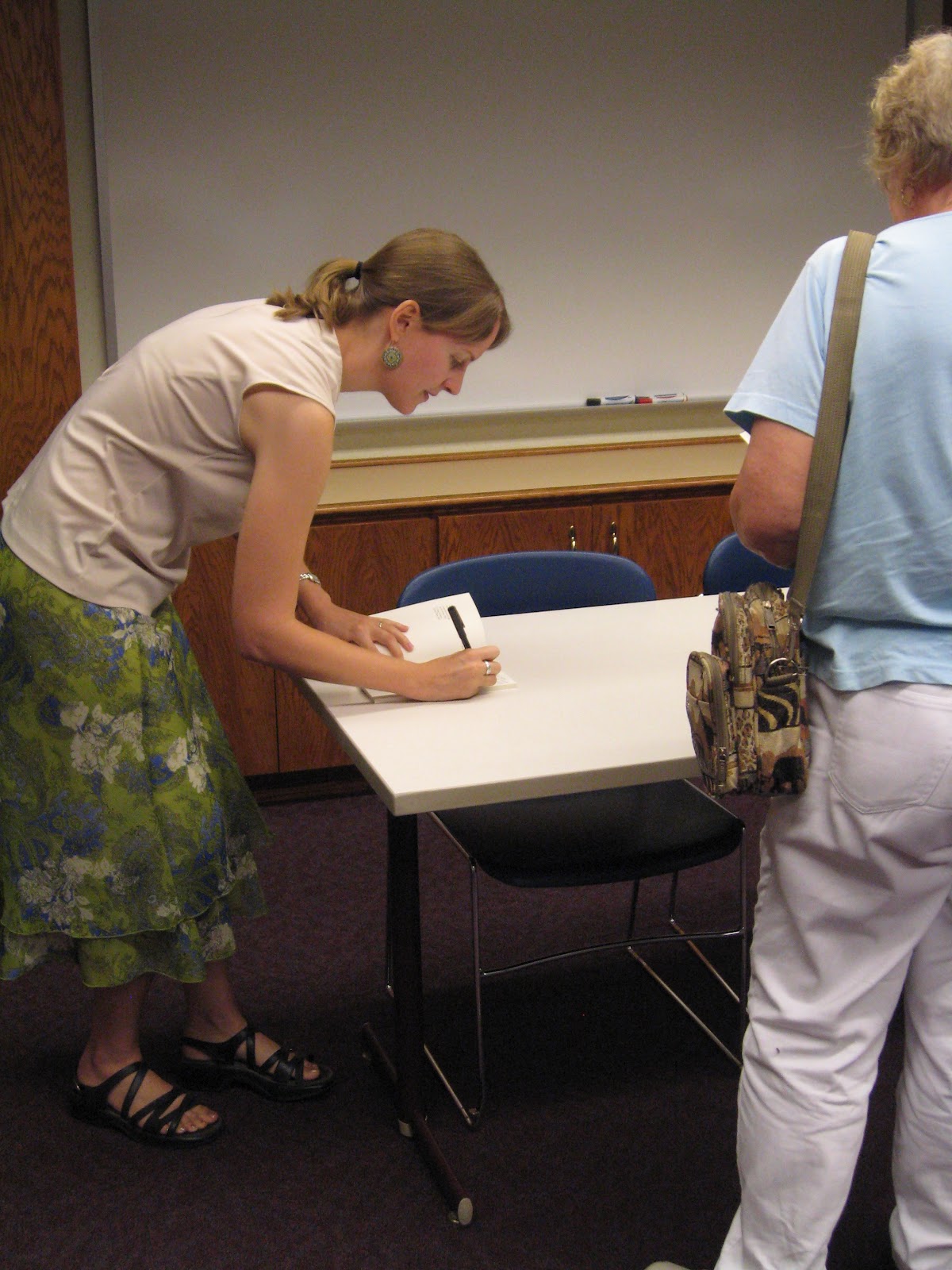
Signing a book at Orrville, Ohio reading.


Performing at the 2012 MennoFolk Festival as "strange light."


                                                      My mom and I both offered workshops
                              for Mennonite teens at the Ohio Conference Youth Retreat.

Bennington College Alumni House w/ some MFA classmates. O second family.

Program from a June reading in NYC at the Cornelia St. Cafe--what a night! I still get shivers.


Thursday, June 14, 2012

Feeding Community: What Undergrads Taught Me This Quarter

After treating my body to its first Thai massage across town yesterday, I meandered home in the sunshine, passing an organic/local-vore bakery, road-side piles of garbage and old furniture left by hordes of exiting undergrads, a couple of left-over students tanning themselves in their front yard while giving their dog beer, and, just as I crested our hill, something I'd never seen before: hummingbird roadkill (!)

This rich and zany diversity often marks a typical day in Athens, Ohio. As a writer, most of the time I am incredibly grateful to live in a place that continually surprises me--even if it happens to also be home to this year's "#1 party school."

I had a tough quarter of teaching undergrads this spring. And I mean tough. Mostly blank, angry stares and deliberately mediocre work. I began to doubt this town, the power of words, the point of a college education. And while I hope at least a few of my English students will take something with them from their required composition course, I know that others were quite happy to get their C+ and just move on.

Here's what saved my sanity this spring, not to mention a belief that there are people out there--even undergrads, perhaps especially undergrads--who can change the world for the better: an Arts for Ohio grant project called "Feeding Community" that I co-wrote/directed with my amazing artist neighbor, Danielle.

Our project paired student papermaking artists with literary artists and had one goal in mind: tell the local food movement story through collaboration.

Over 135 hours of student work later, here's some proof of the end results: http://www.flickr.com/photos/peaspoet/sets/72157629970013072/